
You paid an architect to draw a building. During construction, somebody has to answer the question of whether the building going up is the one on those drawings. That job has a name — construction administration — and it is the service owners cut first and miss most.
It is also the phase where the architect’s role quietly changes. For design, we work for you. Once a contractor signs a construction contract, we pick up a second job on top of the first: reading that contract and saying what it means, for both sides. Those two roles do not always pull in the same direction, and understanding why is most of what this article is about.
What construction administration actually is
It is the architect’s work during the build: answering the contractor’s questions, reviewing what they propose to install, visiting the site, certifying what gets paid, pricing changes, and deciding when the job is finished.
It is not a formality. The construction drawings are the instructions, and a set of drawings for a custom home runs to dozens of sheets with thousands of individual decisions on them. Somebody has to be available when a decision does not survive contact with the field — and something always does not.
The two hats, and why they pull against each other
This is the part almost nobody explains to owners, and it matters.
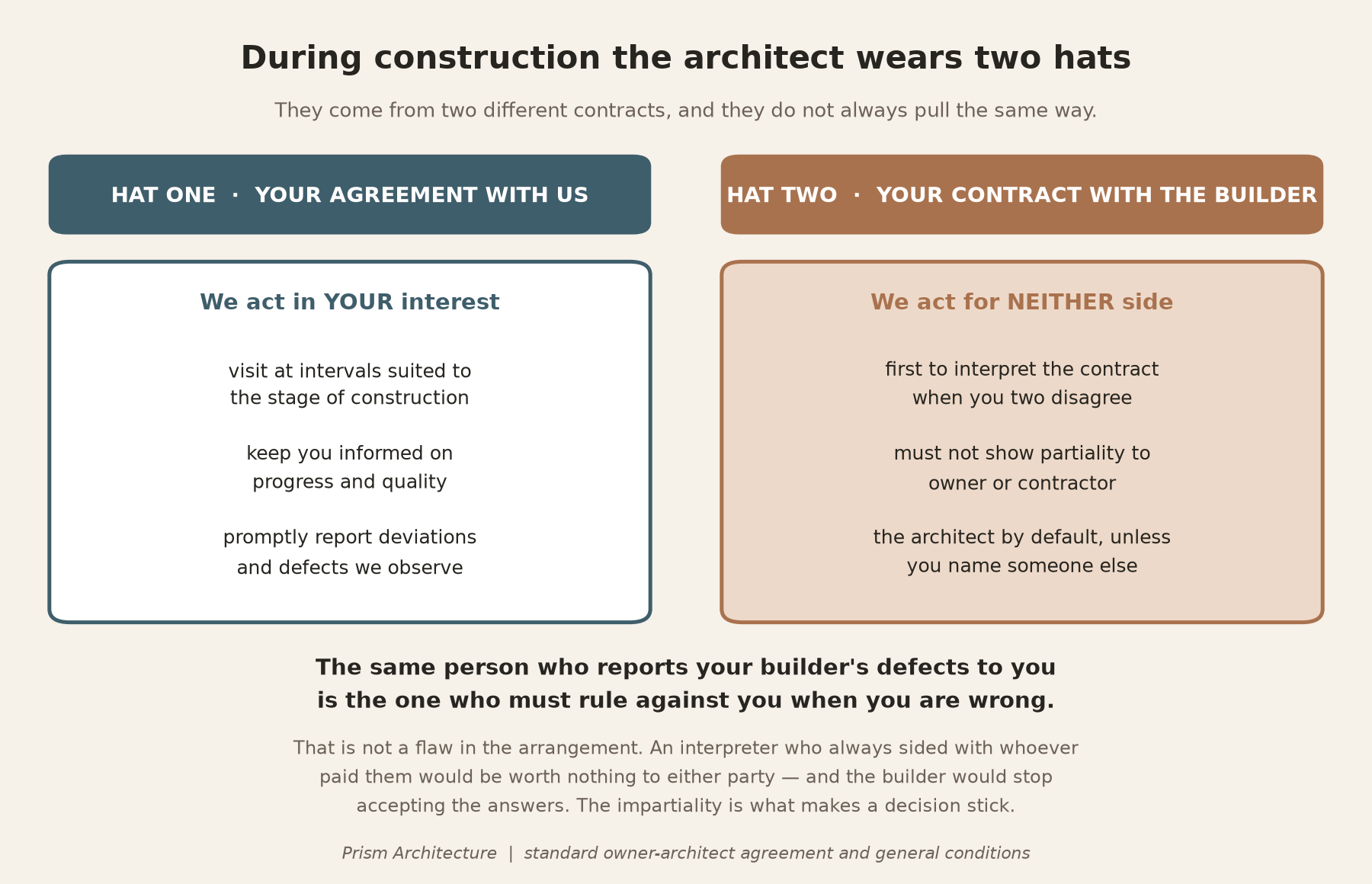
Hat one: we work for you. Under the standard owner-architect agreement, the architect’s construction-phase services are performed consistent with the interests of the Owner. We are required to visit the site at intervals appropriate to the stage of construction, keep you informed about progress and quality, and promptly report known deviations from the contract documents, deviations from the contractor’s schedule, and defects or deficiencies we observe. That is an owner-side duty, in writing.
Hat two: we are the referee. The general conditions of the construction contract — the agreement between you and your contractor — make the architect the first person to interpret that contract when the two of you disagree. In that role the standard says the decision-maker must not show partiality to the Owner or Contractor, and that interpretations must be consistent with the intent of, and reasonably inferable from, the contract documents. Unless you name an independent third party, the architect takes that role by default.
So the same person who reports your contractor’s defects to you is also the person who has to rule against you when you are the one who is wrong. That sounds like a conflict, and it is a real tension — the contractors’ own national association has criticised the arrangement, noting that architects are not specifically trained for a quasi-judicial function.
It is also the reason the service is worth paying for. An interpreter who always sided with whoever was paying them would be worth nothing to either party, and the contractor would stop accepting the answers. The impartiality is what makes the decisions stick.
What it is not
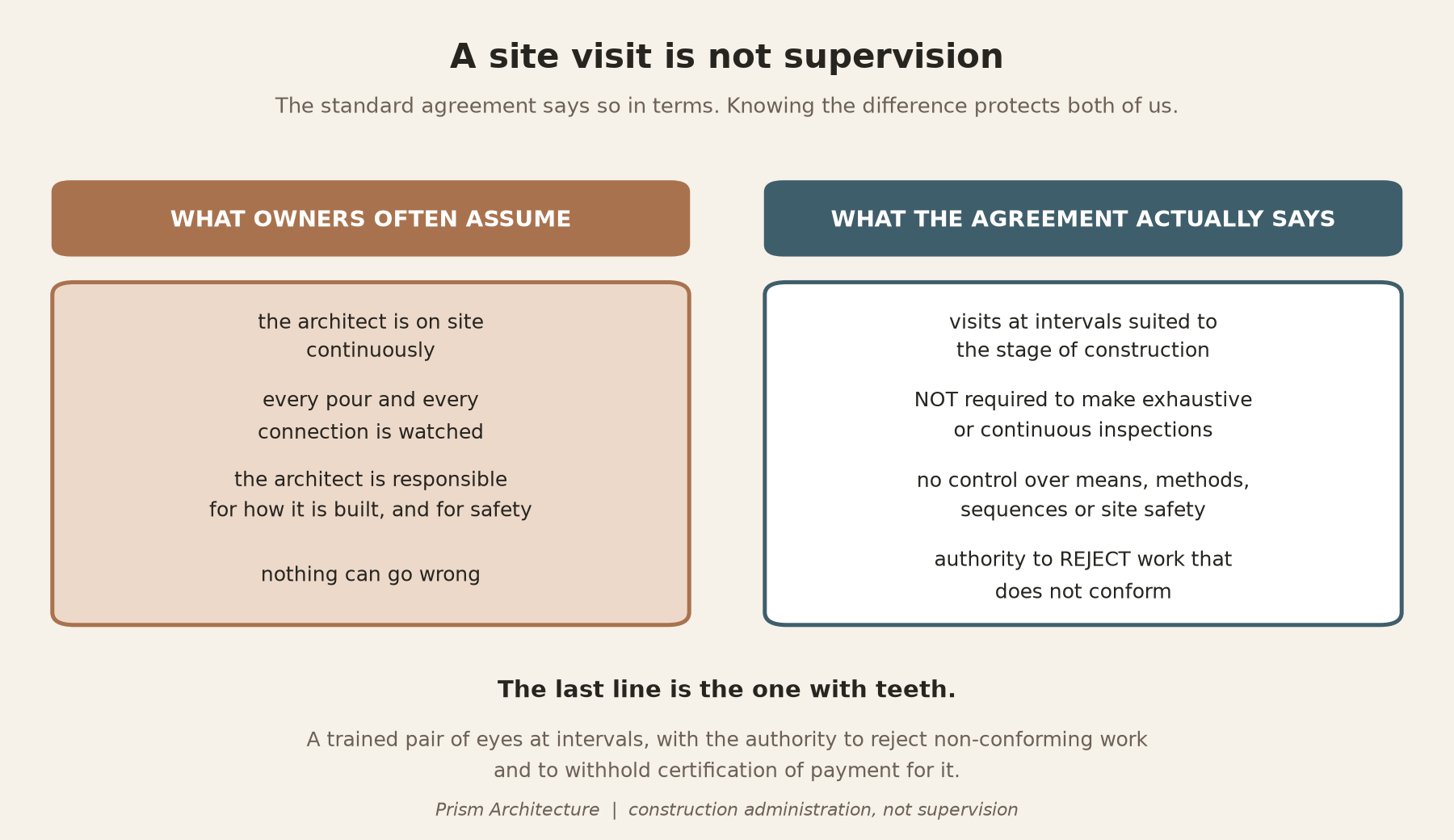
It is not supervision, and the distinction is not a technicality.
The standard agreement says plainly that the architect is not required to make exhaustive or continuous on-site inspections to check the quality or quantity of the work. Visits happen at intervals suited to the stage of construction. If your slab is poured on a Tuesday and the architect’s visit is Thursday, the architect did not watch the pour.
The architect has no control over construction means, methods, techniques, sequences or procedures, and no responsibility for site safety. How the contractor builds it, in what order, and how they keep their crew safe is the contractor’s job and the contractor’s liability. Reviewing a submittal is not approval of the means used to install it.
So construction administration is not a warranty that nothing will go wrong. It is a trained pair of eyes, at intervals, with the authority to reject work that does not conform to the documents and to withhold certification of payment for it. That authority is the teeth.
What actually happens, month to month
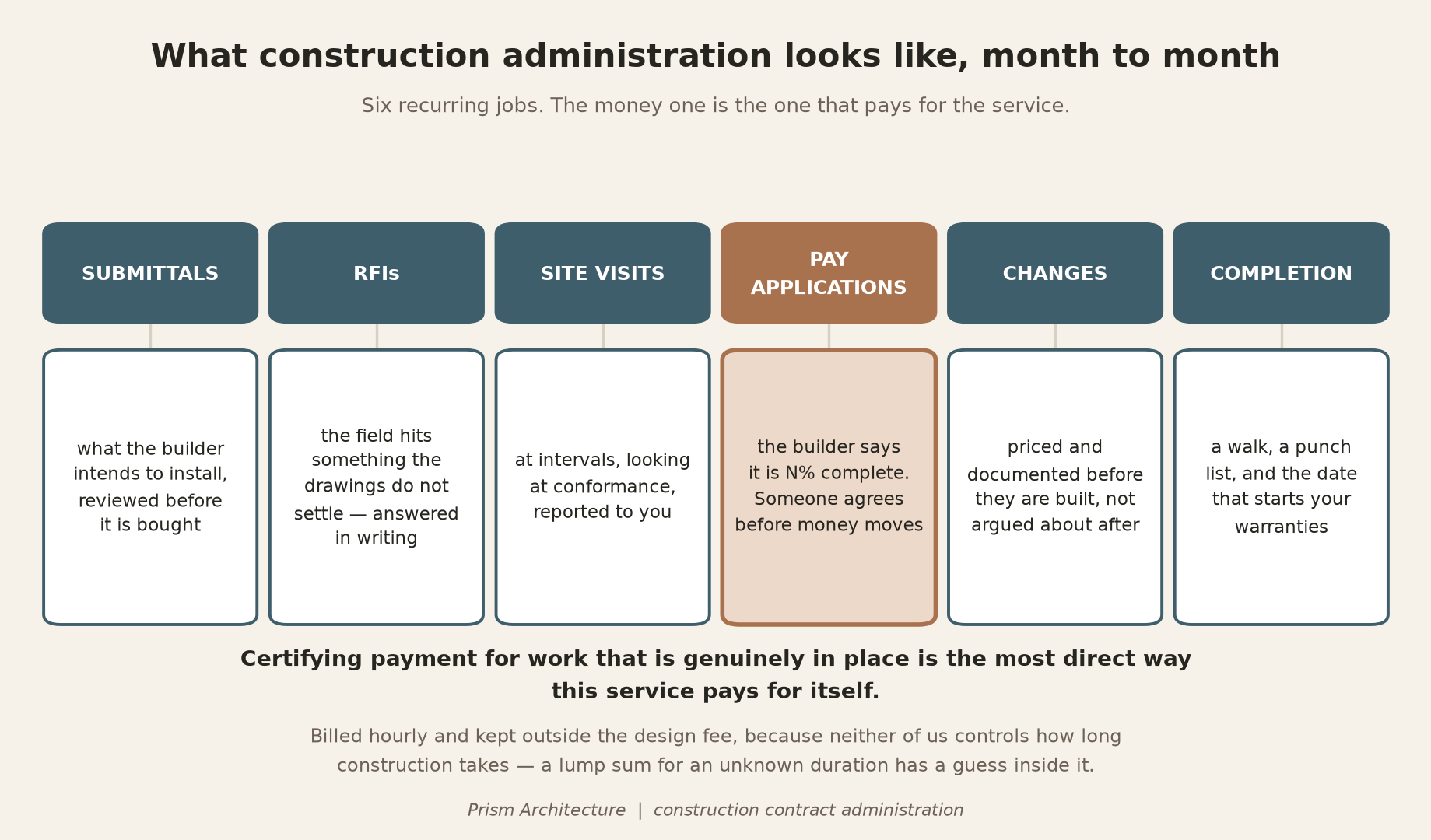
- Submittals. Before most things are installed, the contractor sends what they intend to use — the window package, the truss drawings, the tile, the light fixtures. We review them against the design intent and the specifications and approve, reject, or ask for a revision. This is where a substituted product gets caught, before it is on site and paid for.
- Requests for information. The field hits something the drawings do not settle — an existing condition nobody could see, a conflict between two trades, a dimension that does not close. The contractor asks, and a written answer goes back. In writing, every time, because the answer becomes part of the record.
- Site visits. At intervals, looking at whether the work conforms, and reporting what we find to you.
- Pay applications. The contractor says a percentage of the work is complete. Someone has to agree before the money moves. This is the single most direct way construction administration pays for itself — certifying payment for work that is genuinely in place.
- Changes. Scope moves. Changes get priced and documented before they are built, not argued about afterwards.
- Substantial completion and the punch list. A walk, a written list of what is incomplete or non-conforming, and a determination of the date the building is usable for its intended purpose — which is the date that starts warranties and ends certain contractor obligations.
Why owners drop it, and what it costs
The honest answer: it is a line item with no visible product. Drawings are a thing you can hold. Construction administration is a service you buy to be told, periodically, that things are fine — and when things are fine, it can feel like you bought nothing.
What you are actually buying is the ability to find out early. Non-conforming work found during the framing inspection is a conversation. The same work found at substantial completion is a demolition estimate and an argument about who pays for it. And the person best placed to spot it is the person who drew the thing in the first place.
The second cost is quieter. If the architect is not administering the contract, the contractor is interpreting the drawings alone — reasonably, in good faith, and with every ambiguity resolved in the direction that is fastest to build. Nobody is acting badly. You simply end up with a building shaped by a hundred small decisions you were never asked about.
How we structure it
Construction administration is billed hourly and sits outside the design fee, rather than being folded into a lump sum. That is deliberate and it is in your interest: the length of construction is not something either of us controls, and a lump-sum number for an unknown duration is a number with a guess inside it. You pay for the RFIs, reviews and visits the job actually generates.
What it is worth depends on the job. A straightforward addition with an experienced contractor generates few questions. A custom home with four engineering disciplines and a long schedule generates a great many. Ask for the structure in writing before construction starts, including roughly how often site visits are expected — that frequency is negotiable and it belongs in the agreement, not in an assumption.
Where to start
If you are about to sign a construction contract, three things are worth settling now:
- Decide whether the architect is administering the contract, and put the answer in the owner-architect agreement before the contractor mobilises.
- Check who the initial decision-maker is in your construction contract. If it is blank, it is probably the architect by default. That is normal — just know it.
- Agree the site-visit frequency and the submittal list in writing, so nobody is surprised later about what was and was not being looked at.
Frequently asked questions
Isn’t this the contractor’s job?
No, and it is not a criticism of contractors to say so. The contractor builds the work and warrants their own workmanship. Construction administration is the separate question of whether what is being built matches the documents you contracted for — and the contractor cannot be the one who answers that about their own work.
Does the architect inspect everything?
No. The standard is explicit that site visits happen at intervals and that exhaustive or continuous inspection is not required. Anyone promising continuous oversight is describing a different service — a full-time project representative — which exists, costs considerably more, and should be stated separately in the agreement.
If the architect misses something, is that on them?
The architect is responsible for performing the service to the standard of care — visiting, observing, and reporting what a competent architect would have observed. They are not a guarantor of the contractor’s work, and they have no control over means, methods or safety. The two are genuinely different, and the distinction is written into the standard agreements.
Can the architect stop bad work?
Yes, within limits. The general conditions give the architect authority to reject work that does not conform to the contract documents, and the cost of correcting rejected work falls to the contractor. Note that some owner-modified contracts require the architect to get the owner’s consent before rejecting work — worth checking which version you are signing.
We are self-managing. Do we still need it?
Then you need it more, not less. An owner acting as their own general contractor has taken on the coordination role and still has nobody independently checking conformance with the drawings.
Can we add it later if problems come up?
You can, and it is the most expensive way to buy it. An architect brought in mid-construction has to reconstruct what happened before they arrived from photographs and other people’s recollections. The value of the service is that it is continuous and contemporaneous.
This article is general information about how construction contract administration is structured. It is not legal advice, not a description of the terms of any particular agreement, and not an offer of services on any specific project. Contract terms vary, and owner-modified agreements frequently change the architect’s duties and authority — the governing document is the agreement you actually sign. References to standard-form provisions are cited as published; confirm the edition and any amendments applicable to your project.